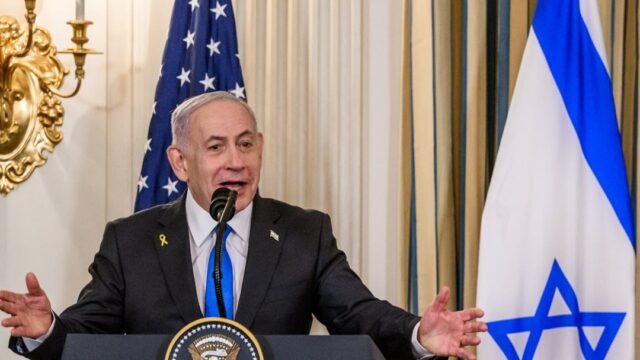
The proposed rotation premiership between Benjamin Netanyahu and Gadi Eisenkot within a national unity government can be read, if finally confirmed, less as an attempt to reach a political agreement than as a calculated maneuver to break up the cohesion of Netanyahu’s rival camp.
As I noted in this morning’s live program, the importance of this offer does not necessarily lie in whether it is implemented, but in the political consequences of the offer being made at all. The proposal itself, before any agreement, unsettles the internal balance of the opposing camp.
By putting a rotation premiership on the table, Netanyahu effectively places Eisenkot before a complicated equation. The Eisenkot camp is made up of currents with different political outlooks whose most important common denominator is removing Netanyahu from power. Bringing Likud into the government-formation equation can erase that very common denominator and loosen from within a coalition built around opposition to Netanyahu.
Meanwhile, Naftali Bennett supports forming a national unity government with Likud, while Avigdor Lieberman has warned about Netanyahu’s intentions. This open disagreement shows that Netanyahu’s offer has real potential to create a split in the rival camp, and that the split is already taking shape before any formal negotiations begin.
If Eisenkot accepts Netanyahu’s offer, he may lose part of his political allies, and if he rejects it, his disagreements with the currents favoring a unity government are likely to grow. In effect, by offering an apparent concession, Netanyahu can transfer the cost of decision-making to the rival camp and influence its internal negotiations; whichever choice Eisenkot makes carries a price for his camp.
Netanyahu does not need a joint government
From a political-strategy standpoint, Netanyahu does not necessarily need to form a joint government with Eisenkot for this maneuver to succeed. Prolonged negotiations, deepening disagreements in the opposing camp and a weakened ability for Eisenkot to form an independent cabinet would themselves be a significant achievement for him. In this equation, time works for the man who put the offer on the table, not for the man who must answer it.
According to reports published in the Israeli media, no final agreement has yet been reached. Netanyahu may be seeking not so much to share power with Eisenkot as to divide the Eisenkot camp. That difference is the key to understanding the political nature of the rotation premiership proposal.
Morteza Esmailpour