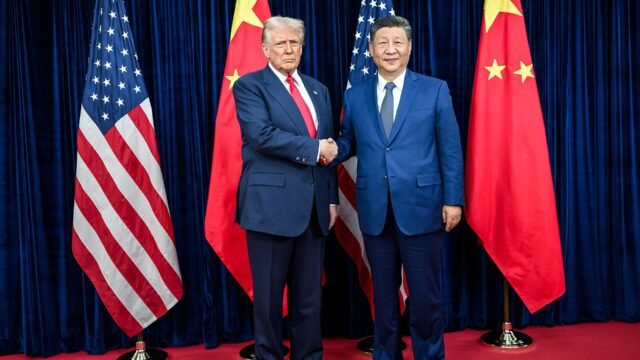
The “unusually active” level of engagement between US President Donald Trump and Chinese counterpart Xi Jinping is masking Beijing’s ongoing efforts to outcompete America economically, technologically and militarily, the US-China Economic and Security Review Commission warned in its annual report to Congress on Wednesday.
The two governments have agreed to pursue what both call a “constructive relationship of strategic stability,” built on an unusually active schedule of leader-level engagement. The commission warned, however, that Beijing is using such meetings to “manage” its relationship with the US while building up its strengths in strategic areas, including data, AI and supply chains for pharmaceuticals and other key sectors. “From a commission perspective, we think we should remain very clear-eyed and sober-minded about what the Chinese interpret that as, which is latitude for maneuver for them, room and space for them to pursue their interests while constraining the United States,” Commission Chair Randall Schriver said.
The commission recommended that Congress pass legislation to further restrict Chinese access to advanced chips, increase oversight of Chinese open-weight AI models, and protect American data from “China and other adversaries.” China controls the vast majority of global rare-earth mining and processing, as well as the supply of several key chipmaking chemicals, and the report said Beijing is “working to replicate that chokepoint position wherever the world depends on it for an input,” from active pharmaceutical ingredients to battery materials and precursor chemicals.
The gap between Beijing’s pledges and its practice is measurable: in the 11 months following the Busan agreement of October 2025, US average monthly imports of rare-earth compounds and metals decreased almost 75 percent. The report also said China’s “aggressive actions to reshape the Western Pacific and force unification with Taiwan are intensifying,” while US contingency planning was focused too narrowly on large-scale invasion scenarios.
Background: Trump and Xi met in Beijing in May and in Washington in September, and are expected to meet for the fourth time this year in December, at the Group of 20 summit in Miami. The meetings have brought a measure of calm to relations strained by last year’s tit-for-tat tariffs, including tariff relief agreements on both sides.
Analysis: Beijing treats negotiation as a way to buy time, not to change course. Every meeting that ends without a real cost for China helps it build another supply-chain chokepoint and another increment of military power. The right policy toward such a rival is the one that has worked against the Islamic Republic: sustained, verifiable pressure, not theatrical calm.
Source: Nikkei Asia