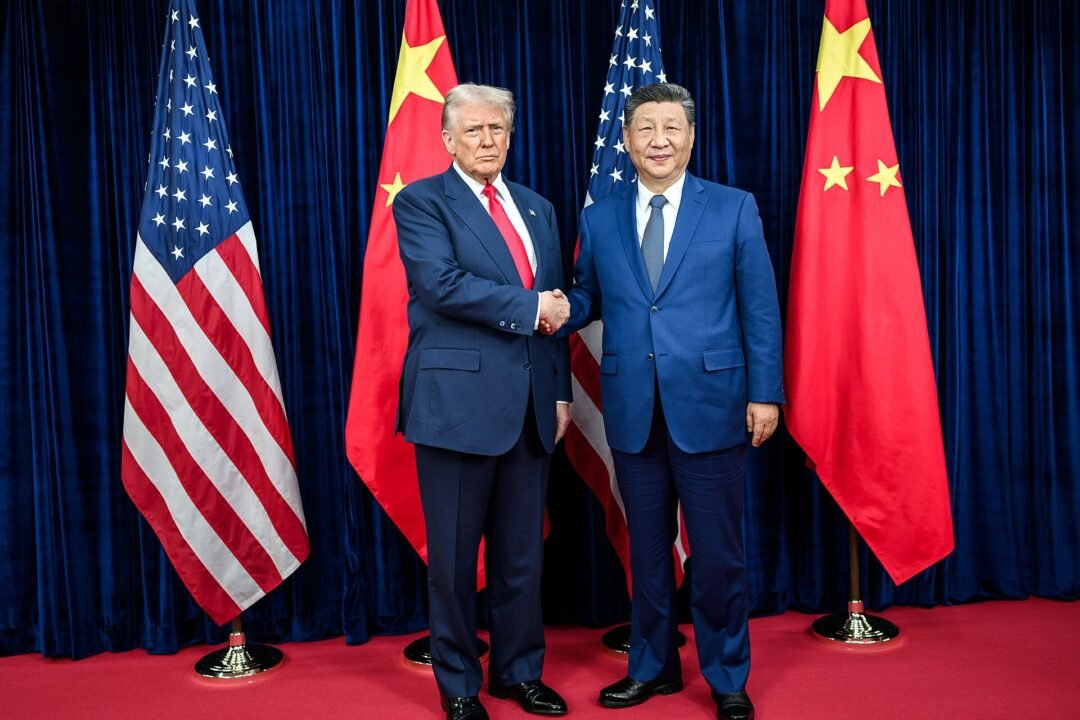
The leaders of the U.S., Russia and China are set to meet in the Chinese tech metropolis of Shenzhen on Thursday, in an event hailed as “historic” by all sides. Among the topics raised for discussion are reductions in global nuclear stockpiles. But experts caution that while the meeting itself is a positive development, any major breakthrough remains unlikely.
Expectations for the get-together ratcheted up over the past week, particularly in Russia, where the event has taken on undertones of a “Yalta 2.0,” referencing the 1945 conference that reordered the world after World War II. From the U.S. side, the Trump administration surprised many observers by pushing for discussions about reducing nuclear weapons. The last strategic arms control treaty between Russia and the U.S., New START, expired in February, leaving the two largest nuclear states without numerical limits on atomic arsenals for the first time since 1972.
China was never a party to New START and has never been part of any strategic arms treaty like it. Beijing is estimated to have the third-largest nuclear arsenal in the world, at several hundred warheads, although analysts believe it has been working to significantly increase that number in recent years. The U.S. and Russia each have stockpiles of around 4,000 nuclear weapons.
This numerical discrepancy is also why China has previously bristled at the idea of strategic arms limitation in the trilateral format Trump has been pushing. Beijing has confirmed the meeting but stopped short of officially saying strategic arms dialogue would be on the agenda. “The three presidents will have an in-depth exchange of views on safeguarding world peace and enabling strategic stability in major-country relations,” said Mao Ning, spokesperson for the Chinese Foreign Ministry, language that avoids naming explicitly what the U.S. has asked for.
White House spokesperson Olivia Wales told reporters last Friday: “The President has made it clear that, among other topics, he will discuss the reduction of nuclear weapons in the world. This proliferation, President Trump believes, is very dangerous.”
Nikita Degtyarev, research coordinator at the Vienna-based Open Nuclear Network, was realistic about achievable outcomes. “I don’t have very high expectations, but I’m happy that it’s happening,” he said. “A meeting at the leader level is something else than the ongoing P5 dialogue and other existing formats.” The most likely significant outcome, he said, would be a reiteration of the Reagan-Gorbachev mantra that a nuclear war cannot be won and must never be fought; a substantive agreement was unlikely because lower-level officials simply had not had time to hammer out details leaders could sign. Major arms control treaties often take years of meticulous crafting at the working level.
Heather Williams, director of the Project on Nuclear Issues at CSIS, agreed: “If there is any outcome of the trilateral meeting relating to nuclear issues, it will likely be more of a political statement than a verifiable and restrictive arms control agreement.”
A possible wildcard is artificial intelligence in nuclear weapons. AI in nuclear command and control has emerged as a more promising topic and a potential area of agreement more palatable to all sides than numerical reductions or verification mechanisms. Working-level teams have reportedly discussed AI in critical weapons systems, with the agenda shifting toward common ground on AI’s role in nuclear command and control, characterized by one source as an “easy deliverable.” Under the previous administration, Biden and Xi reaffirmed the importance of human decision-making in nuclear command and control in November 2024, while Russia has so far resisted such language.
Much may depend on Beijing’s willingness to engage in strategic arms dialogue, which it has shown little desire to discuss while it remains the numerical underdog. “China is the host and will probably closely stage-manage the event and agenda,” Degtyarev said. The common denominator for all three leaders is more likely good publicity. And though the meeting is historic for assembling the world’s three most powerful leaders, “the Yalta 2.0 comparisons are overblown,” he said. “The scale of the historical moment is simply different.”
Background: New START’s expiry in February removed the numerical ceiling on the strategic arsenals of the world’s two largest nuclear powers for the first time in more than half a century. China, which has never accepted arms limits, is expanding its arsenal as the three nuclear leaders sit down together for the first time in Shenzhen.
Analysis: For Washington, Shenzhen carries two messages at once. Trump wants to present himself as an architect of disarmament, but the field reality is that no ceiling binds Russia’s arsenal and China is building at speed. Until Beijing accepts transparency and limits, the summit’s best case is a symbolic statement. The lesson travels to our region: the great powers only negotiate seriously with strength demonstrated on land and at sea, the same pressure now being applied to the regime in Hormuz.
Source: Defense News