
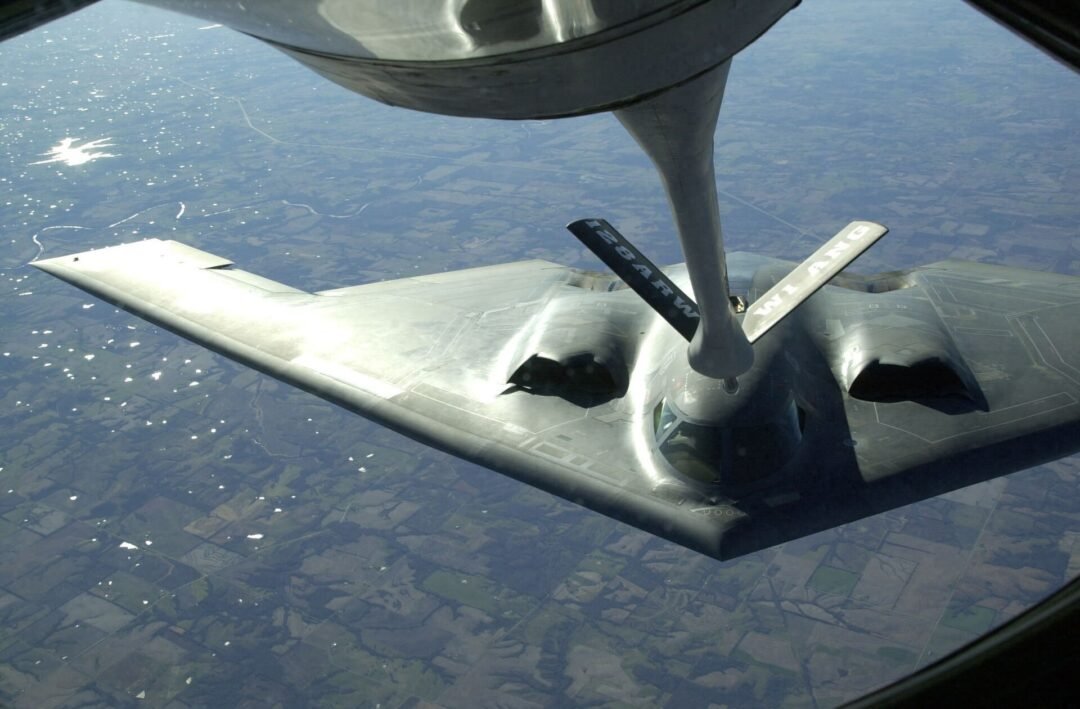
On the night of June 21–22, 2025, Iran’s skies witnessed an operation the Pentagon called the largest B-2 operational strike in American history. Seven B-2 Spirit bombers lifted off from Whiteman Air Force Base in Missouri and flew east for 18 hours in near-total radio silence. Another part of the bomber package headed west over the Pacific, drawing satellite eyes and the regime’s intelligence services toward Guam — a deception that, in the words of Gen. Dan Caine, Chairman of the Joint Chiefs of Staff, was known to only a handful of planners in Washington and at CENTCOM headquarters in Tampa.
Along the way, the bombers refueled in mid-air multiple times. Over the Middle East, fifth-generation F-22 and F-35 fighters joined the strike package and swept ahead of it into Iranian airspace. Shortly before the bombers crossed into Iran, a U.S. guided-missile submarine launched more than two dozen Tomahawk cruise missiles at surface infrastructure at Isfahan. Then, at 2:10 a.m. Iran time, the first GBU-57 bombs fell on Fordow.
The GBU-57 is the heaviest conventional penetrating bomb in the world — some 30,000 pounds — and the B-2 is the only aircraft that can carry it. The weapon had been developed and tested for more than a decade for exactly one kind of target: a deeply buried, hardened facility like Fordow. That night it was used in combat for the first time. Fourteen GBU-57s were dropped in all: twelve on Fordow, where enrichment halls were hidden inside a mountain under dozens of meters of rock, and two on the underground section of Natanz. The operation involved more than 125 aircraft and roughly 75 precision-guided weapons, and the B-2 crews completed a round trip of about 37 hours without landing. According to the Pentagon, not a single shot was fired at the American aircraft during the entire operation; the regime’s air defenses were either caught by surprise or did not dare to react.
The invisible backbone of the mission was the tanker fleet. Dozens of KC-135 and KC-46 aircraft built a chain of aerial refueling stations along the route out and back, so that bombers arriving from the other side of the planet still had full tanks over the target; published estimates put the number of tankers used in the operation itself at around 50. Without that chain, no strategic bomber can take off from Missouri and strike Fordow.
Today, that chain has become a permanent and enormous network. According to situation reports on U.S. forces in the region, roughly 200 KC-135 and KC-46 tankers from seven refueling wings are stationed across European bases and the CENTCOM area, and an open-source tracker counted exactly 203 to 205 of them on November 11, 2026 — the highest number since June. Alongside two aircraft carriers on station in the Arabian Sea and a third that has now arrived, some 200 fighters, and a naval blockade of the regime’s ports that has run for more than 100 days, the message is singular: America does not merely have the ability to strike; it has positioned the ability to strike continuously, night after night, in front of the regime’s eyes.
Background: Operation Midnight Hammer was the product of roughly 15 years of planning and weapons development. The Pentagon’s initial assessment described extremely severe damage at all three sites, and the Secretary of Defense spoke of the nuclear program’s destruction; in September 2025 the International Atomic Energy Agency, citing satellite imagery, assessed that Fordow was expected to have suffered very significant damage, though the status of the underground nuclear material remains unknown to the agency. The figure of 203 tankers is an open-source tracker’s count cited in the November 2026 situation report of Israel’s Institute for National Security Studies (INSS), and Fox News reported the same figure; the network spans both European bases and the CENTCOM area.
Analysis: Fordow was supposed to be the insurance policy for the regime’s nuclear program — a facility buried inside a mountain that no bomb could reach. Midnight Hammer proved that no such sanctuary exists: when the United States decides to act, the world’s heaviest conventional weapon arrives from across the ocean, passes over the regime’s helpless air defenses, and hits the exact point the regime spent 15 years and a fortune trying to hide. The hard core of the nuclear program — the deep, hardened enrichment at Fordow and Natanz — was put out of action in a single night. The 203 tankers now in the region mean that capability was no one-night demonstration; the naval blockade is strangling the regime’s oil income while the refueling network holds the sky open for a repeat strike at any moment. The regime is trapped between two choices: submit to the pressure, or watch the rest of its infrastructure collapse. Both roads lead to the end of the path that began at Fordow.