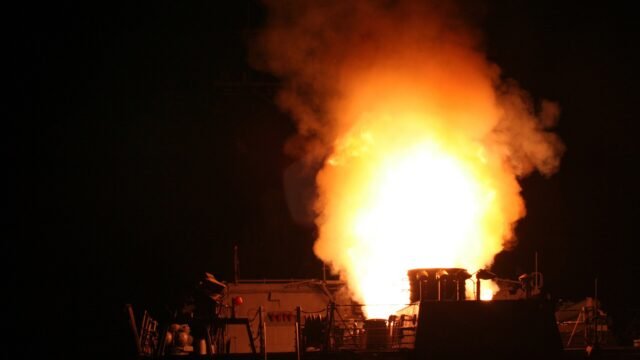
South Korean defense giant Hanwha said it successfully launched missiles from a palletizable multi-pod launcher system at sea on Sunday, demonstrating how heavy maritime strike power has shrunk to the size of shipping containers.
Hanwha Defense USA fired two Chunmoo missiles from a test range vessel operated by the Spaceport Company off the coast of Mississippi, the company announced in a Tuesday release. The Chunmoo is a self-propelled multiple rocket launcher designed and produced by Hanwha. Its central asset is its extreme versatility: it can fire an array of different missiles, including munitions with and without precision-guiding systems.
The U.S. Navy has been pushing for containerized weapons systems over the past year, and in March Admiral Daryl Caudle announced a program to shift the Navy toward modular, containerized systems that can fit onto most vessels and are easy to modify and deploy. Addressing the fleet in April, Caudle announced a new “Containerization Plan” and emphasized that the Navy’s future will focus on adaptable technology that integrates across multiple domains rather than platforms designed for a single purpose.
“Containerization allows us to decouple payloads from platforms. To rapidly reconfigure forces. To tailor capability to mission. To scale effects across the entire Fleet,” Caudle said. “This is how we emphasize payloads over platforms in practice. It turns every platform into a potential combat node. And every payload into a scalable weapon.” “If it fits in a container, I want it and I should be able to fight anywhere in the world with it across many, many platforms,” he added.
The demand for containerized systems extends to unmanned sensors and systems such as unmanned underwater vehicles. In March, the Navy chose Anduril to design an unmanned underwater vehicle for its Combat Autonomous Maritime Platform program based on the design of its Dive-XL vehicle, one of whose standout features is that it fits neatly into commercial shipping containers, making it easy to transport and deploy.
According to Hanwha, the palletized launcher system demonstrated on Sunday can be used by both crewed and uncrewed systems. That means autonomous surface vessels could potentially equip multi-rocket launchers previously reserved for ground combat, effectively becoming floating launch pads for heavy firepower.
Kevin Schoonover, Hanwha Defense USA executive vice president, said the company is responding to the Navy’s demand for modern maritime strike capabilities: “By pairing Hanwha’s flagship Chunmoo missile and its palletized platform with next generation crewed and uncrewed vessels, we can deliver capabilities for the Navy at scale and a fraction of the cost of other systems.” The data collected in the test, he said, will help shape future distributed maritime operations and expeditionary strike capabilities for both palletized and containerized launcher concepts.
Background: A palletized launcher rides on a standard flat base that can be craned onto a deck and made ready to fire without altering the ship’s structure. The approach turns any support vessel, or an uncrewed one, into a firing platform within hours.
Analysis: The war with the Islamic Republic has taught the U.S. Navy that firepower must be distributed, not concentrated in a handful of expensive hulls. The containerized Chunmoo is precisely the answer Caudle’s plan is looking for: cheap, numerous fire that can ride on almost any deck. For blockade and patrol duty in Hormuz and the Red Sea, such platforms mean the regime must treat every passing hull as a potential warship, an equation that raises the cost of Tehran’s maritime game still further.
Source: Military Times