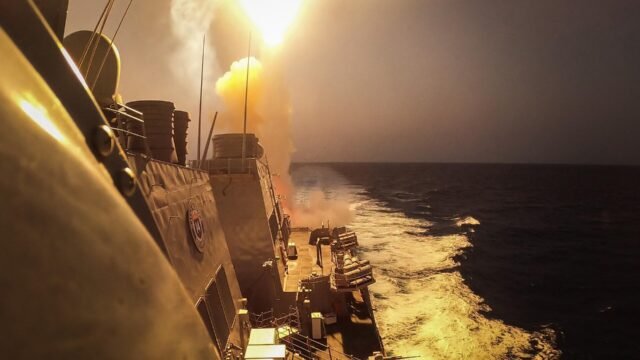
President Donald Trump’s pick to lead the U.S. Navy acknowledged the strain of the Iran war on Tuesday, as senators from both parties pressed him at his confirmation hearing about the impact of long ship deployments on sailors, drawdowns to stockpiles of advanced weapons and resources being shifted away from countering China.
Hung Cao, a Trump loyalist and combat veteran, is seeking the Navy’s top civilian job during a particularly volatile time in Washington. He also faces the extra hurdle of needing a waiver from Congress, because he left active-duty service less than seven years ago.
“This war, again, I know it’s a strain on our Navy,” Cao told the Senate Armed Services Committee, but he insisted that “it’s really set China back on their heels” to see all the military services work together.
Sen. Elizabeth Warren, a Democrat from Massachusetts, grilled Cao on the costs of the Iran war, noting that independent estimates and media reports put the naval blockade on Iranian shipping at about $32.5 million a day and the damage from Iranian strikes on the Navy’s regional headquarters in Bahrain at at least $400 million. Cao confirmed the blockade figure but said he could not offer a full damage assessment in Bahrain because “it’s a nonpermissive area for us to go,” despite having told a reporter months ago that Iran “blew the hell out of Bahrain.”
The hearing offered a rare opportunity to question a top military leader publicly about the Iran war and other issues. It followed recent firings of Navy officials and a failed impeachment attempt in the House against Defense Secretary Pete Hegseth, partly over his handling of the eight-month-old conflict. Republicans lost the House and Senate in the midterm elections, which were widely seen as a repudiation of the war and will put Democrats in control of Congress in January.
Cao was also asked about living conditions and mental health during long deployments, following reports of crew stress and supply shortages aboard the aircraft carrier Abraham Lincoln and other ships. The Lincoln endured a record-breaking deployment supporting the Iran war before returning to its homeport of San Diego in October. Republican Sen. Roger Wicker of Mississippi, who chairs the committee, noted that the “incredibly challenging deployments” take a toll on sailors and their families. Sen. Mark Kelly, a Democrat from Arizona, said his office had received “reports of not enough food and inadequate basic necessities” from other deployed warships. “One parent told us that there’s their kid, lost more than 45 pounds in six months because of a lack of food,” Kelly said. Cao said he was focused on sailors’ welfare but argued that sailors going hungry was “like my kids opening up the refrigerator door and saying there’s nothing to eat in here.” Asked about suicide attempts aboard the ships, Cao told Sen. Richard Blumenthal of Connecticut that what he saw “as eight suicide attempts, I see as eight suicide mitigations.”
On munitions, GOP Sen. Deb Fischer of Nebraska pointed to dwindling stockpiles, and fellow Republican Sen. Joni Ernst of Iowa noted the strain of maintaining the blockade on Iranian shipping. Sen. Jack Reed of Rhode Island, the committee’s ranking Democrat, said “the munitions expended and damage sustained from Operation Epic Fury alone will take years to recover.” Cao said production of Tomahawks and other weapons has been boosted: “When I was in uniform, we only produced 125 Tomahawks a year. Right now we’re well above 60 every month.” He said efforts are also under way to boost production of the interceptors Navy ships use to shoot down incoming missiles. He also conceded that the Navy has taken to using expired munitions, which were recoded and fired, without identifying the specific munitions involved.
Democrats also pressed Cao on the Navy’s failure to inform Congress that it fired the entire leadership team of a nuclear-powered attack submarine after an underwater collision, and separately fired the commander of a destroyer deployed to the Middle East. Cao argued against the Navy’s traditional policy of publicly announcing the removal of commanders, saying he wants “to make sure that we don’t destroy their careers.”
Trump nominated Cao in September. He has served as acting Navy secretary since April, after John Phelan’s departure, and was previously Navy undersecretary and an unsuccessful Republican candidate for the Senate in Virginia in 2024. Cao fled Vietnam with his family as a child in the 1970s, attended the U.S. Naval Academy and served as a special operations officer with SEAL teams and special forces in Iraq, Afghanistan and Somalia. He left active duty in 2021 and needs a waiver of the law barring officers from serving as a service secretary until seven years after retirement, a rule in place since the end of World War II to ensure civilian control of the military.
Background: Cao’s hearing was Congress’s first full public accounting of the eight-month Iran war’s human and material costs: a blockade running at roughly $32.5 million a day, hundreds of millions of dollars in damage in Bahrain, and a fleet sustaining near-year-long deployments to hold the blockade and defend regional bases.
Analysis: The hearing’s numbers describe a war of attrition in hard figures. The blockade is working and is throttling the regime’s economy, but the bill is being paid in worn ships and draining stockpiles. The jump in Tomahawk output, from 125 a year to more than 60 a month, shows Washington has absorbed the war’s central lesson: pressure on the Islamic Republic is sustainable only when industrial production stands behind it. America’s problem today is not the will to fight; it is the capacity to build.
Source: Associated Press