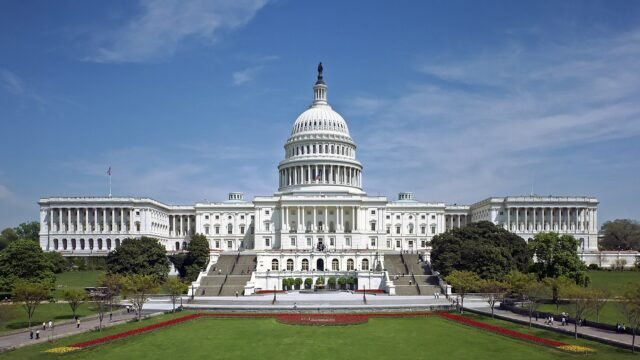
Senate appropriators reined in President Donald Trump’s $17 billion-plus Golden Dome request this week, pushing roughly half of the administration’s ask into a draft defense bill and signaling that long-term funding for the homeland missile-defense system cannot rely on one-time measures facing uncertainty in the lame-duck Congress.
Nearly all of the $17.5 billion Golden Dome request is tied up in reconciliation, and only about $398 million of the administration’s base budget request was allocated for the program. In their fiscal 2027 defense draft, the GOP-led Senate Appropriations Committee tagged nearly $9.4 billion for Golden Dome, a steadier funding vehicle, saying the administration’s reliance on reconciliation measures “threatens the success” of the program.
“The chances of Golden Dome getting the full $17 billion requested are now almost zero,” Todd Harrison, a defense budget analyst with AEI, told Defense One. “The best they’re gonna get is probably $9 billion, and in all likelihood, it’ll be less than that.” Harrison said the program will likely have to rethink the scope of its architecture and how fast it can move.
Program officials, meanwhile, tout operational progress. Golden Dome Deputy Director Marcia Holmes told an audience Tuesday that a key component of the system, a command and control platform meant to connect disparate threat-tracking technology, has recently been successful in testing, drawing lessons from the Iran war. “The multi-domain coordinated defense operations executed recently in the Middle East, repelling massive synchronized silos of ballistic missiles, land attack cruise missiles, and drones, have been a goldmine of real-world operational data for our C2 development,” Holmes said. “That fight proved that when you seamlessly share tracks, allocate engagements, and deconflict fires across multinational and multi-service assets, mass attacks fail.” The administration is still seeking a total of $185 billion for the program’s long-term sustainment, with the goal of reaching initial operating capacity in 2028.
Background: Golden Dome aims to build an interconnected suite of interceptors, sensors and defenses to protect the US homeland from missile and aerial threats. The Congressional Budget Office recently estimated its 20-year cost at $1.2 trillion, far above the administration’s figures, and the program received more than $24 billion through the One Big Beautiful Bill Act last year.
Analysis: The Washington fight over Golden Dome is about the funding route, not the need. The war with the Islamic Republic proved that synchronized mass attacks by ballistic missiles, cruise missiles and drones are a real threat, and that layered multinational defense defeats them. Every month of funding uncertainty widens the gap between a growing threat and the shield meant to stop it.
Source: Defense One