In a dark corner of a convention center in suburban France, a British company may hold the next design for America’s newest warship.
A model of the “Type-31 Arrowhead” (Type-31 Arrowhead) was on display last week on a table at Babcock International’s booth at the Euronaval exhibition. It was one of half a dozen candidates for the U.S. Navy’s foreign frigate competition; a competition the White House has designed to launch a new wave of shipbuilding and investment in America.
With the Trump administration’s continued pursuit of foreign designs and shipbuilding for warships, several European defense companies at the biennial conference were eager to talk about the options they could offer in a possible international competition if the United States came knocking.
The U.S. Navy currently has two frigate designs under construction in the United States. Fincantieri Marinette Marine is still building the first two Constellation-class (Constellation-class) frigates at its yard in Wisconsin, after John Phelan, the former secretary of the Navy, canceled the program a year ago. Meanwhile, HII’s Ingalls Shipbuilding has a long-term contract to start the FF(X) frigate, which is based on the U.S. Coast Guard’s National Security Cutter.
According to USNI News, although a successful frigate program has eluded the U.S. Navy for decades, the service is working toward using a foreign design for a new class of ships in the next few years.
According to Bryan Clark, a naval analyst at the Hudson Institute, the work requirements for a new frigate are almost complete. The Navy now prioritizes frigates that can escort other ships, instead of conducting anti-submarine warfare, which was the main mission of the canceled Constellation-class program. According to Clark, the service wants a platform that can enforce a blockade and protect against medium-level threats — such as those the military currently faces in U.S. Central Command.
“A frigate can defend against the type and scale of threat we see from the Iranians. Not really [anti-submarine warfare] — more doing this kind of sea control and maritime security mission,” Clark told USNI News before Euronaval.
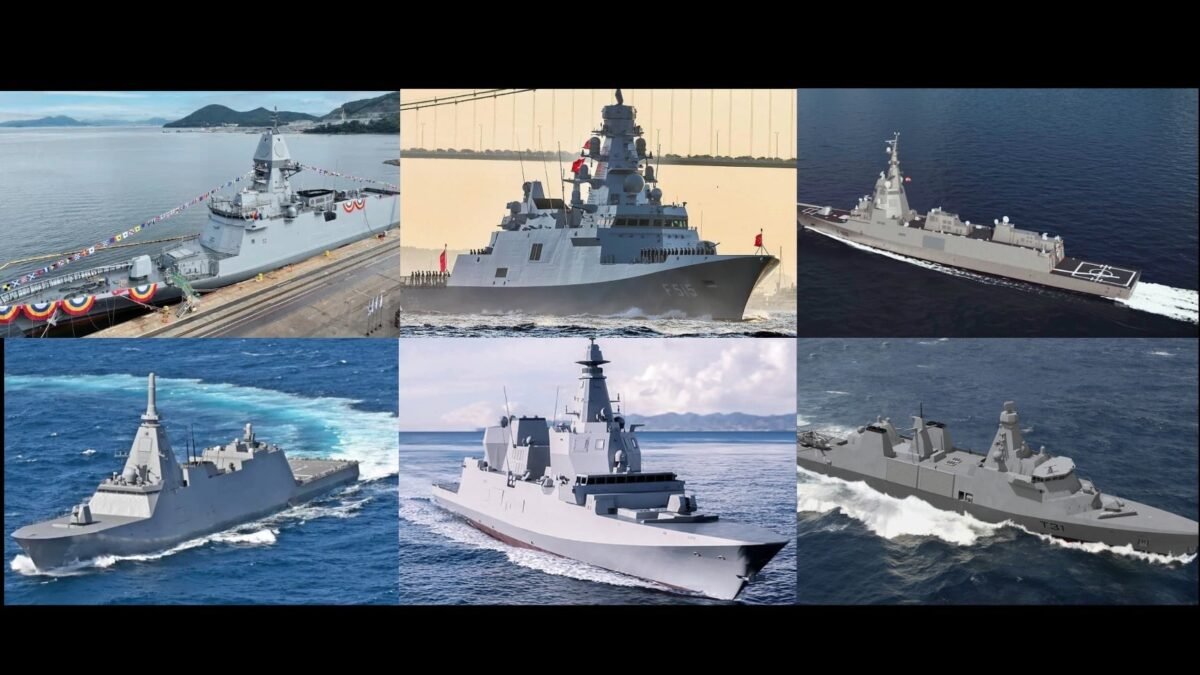
To that end, six designs from around the world have been put forward as possible candidates for an international competition that would adhere to the same competition President Donald Trump called for in his August shipbuilding memorandum. The White House document asked the Navy to follow the so-called “Finland model”; a model in which construction can begin at a foreign shipyard for at most the first two hulls, before foreign investment in U.S. shipbuilding infrastructure. The White House is using the Finland model to accelerate the Arctic Security Cutter program, building two separate designs at shipyards in Finland, Texas and Louisiana.
Russ Vought, director of the White House Office of Management and Budget, has been explicit about using the same model for small surface combatants and support ships. But Congress has resisted the effort and has included draft language in both the House and Senate versions of the fiscal year 2027 National Defense Authorization Act that would bar the Navy from buying foreign-built warships. Congress is more open to buying support ships abroad.
Despite congressional resistance, an August memorandum laid out the roadmap for that competition — a plan prepared by Pete Hegseth, the secretary of defense, and Hung Cao, the acting secretary of the Navy. The plan was due to reach the White House on Thursday.
The Candidates
Babcock has maintained a partnership since 2023 with HII, the leading U.S. shipbuilder, as part of the AUKUS security pact. The British company is also working with HII on the Romulus unmanned surface vessel, which Britain’s Royal Navy is buying.
Sir Nick Hine, Babcock’s chief executive for marine, said he thought the Type 31 frigate could meet the U.S. Navy’s need for a small surface combatant. According to the White House memorandum, that platform must be able to perform “anti-submarine warfare, surface warfare and convoy escort duties.”
According to Hine, the Type 31 frigate could act as a command ship in a fleet that includes a mix of crewed and uncrewed ships. Babcock has previously worked with Lockheed Martin, meaning the platform could integrate the Aegis combat system and the AN/SPY-7 radar. The design also has a Mark 41 launcher with 32 vertical launching system cells, but Hine says it could potentially accept more cells.
“Navies are always short of two things, even yours; short of money and short of people,” Hine, making the case for the Type 31, told USNI News on the sidelines of Euronaval last week.
He added: “You need a cheaper frigate, because the cost of some of these platforms is insane, and you need a platform with fewer people on it, because you don’t have enough people. The Type 31 was designed to be more adaptable, more affordable and more available, and was designed with fewer people. It was designed for a crew capacity of 100 people, no more than 100 people. It’s 6,000 tons, 140 meters long, and so it was designed for operations in the North Atlantic; that is, it was designed for operations in high sea states for long periods.”
According to Hine, to field the platform more quickly in the U.S. fleet, the hull could be built abroad to the point where it is ready to move, while the combat system is integrated in America.
Another option is from Spain’s Navantia, which is working on an export version of the Bonifaz-class F-110 (Bonifaz-class) anti-submarine warfare frigate.
Juan de la Cueva, Navantia’s commercial director, told USNI News during a wine-and-tapas reception in the convention center hall that Navantia, which partners with Lockheed Martin on the F-110, intends to submit a bid if the U.S. Navy issues a request for proposals.
“All of Navantia’s ships have an American heritage, because we come from a very long-standing relationship with the United States. We learned how to build ships from Bath Iron Works and Gibbs & Cox. So these ships pass [Naval Sea Systems Command] standards,” de la Cueva said.
De la Cueva pointed to Navantia’s long-standing relationship with major U.S. yards such as General Dynamics Bath Iron Works and HII. The company has already provided some information to the U.S. Navy and is waiting to hear the competition’s next steps.
De la Cueva said a U.S. version could have Lockheed Martin’s Aegis combat system and the SPY-7 air defense radar.
In addition to the British and the Spanish, the Italians also have an option for America, if it launches an international competition. Fincantieri Italy, which has its own U.S. subsidiary at Marinette Marine in Wisconsin, could offer the FREMM EVO. The platform is an updated version of the FREMM multipurpose frigate, which the United States used as the parent design for the Constellation class.
“I would call us untapped capacity,” George Moutafis, chief executive of Fincantieri Marinette Marine, told USNI News in September.
The yard is still completing the Royal Saudi Navy’s Multi-Mission Surface Combatant, while building the first two Constellation-class frigates and preparing to build the Marine Corps’ medium landing ship.
“This is the evolution of the original version, meaning all the advantages are still there,” Moutafis said of the FREMM EVO.
He said: “The hard lines that work well for the [anti-submarine warfare] mission are all there, and they’ve worked on areas that you think are attractive — you know, making it more lethal, preparing it energy-wise for future growth for future missions, bringing in capabilities that again relate to the anti-submarine warfare mission — and at the same time identifying ways it can integrate well with employing, recovering and managing unmanned elements in all domains.”
The Wisconsin yard currently has about 2,200 employees and, if it receives a contract to build more frigates, would need to hire about 500 people over time.
USNI News previously reported that other possible designs could come from Japan, South Korea and Turkey.
According to two sources who previously told USNI News, after a conversation between Trump and Turkey’s leadership on the sidelines of the NATO summit in July, the Istanbul-class (Istanbul-class) guided-missile frigate, built by several Turkish shipyards, entered the mix.
Perhaps the country most associated with the current conversation about foreign shipbuilding is South Korea, which has committed to invest $150 billion in the U.S. shipbuilding industry; as part of an ongoing trade deal with the Trump administration. USNI News has learned that the Chungnam-class (Chungnam-class) guided-missile frigate, built by several South Korean companies, is one of the options on the table. Meanwhile, the export version of the Mogami-class FFM (Mogami-class) guided-missile frigate, built by Japan’s Mitsubishi Heavy Industries, is also on the table.
Although the Trump administration has repeatedly made clear its preference for an international competition, the Navy has faced setbacks when pursuing foreign designs.
USNI News reported in 2024 that when Gibbs & Cox modified the FREMM parent design for the Constellation-class program, it applied so many changes to meet U.S. Naval Sea Systems Command requirements that commonality between the FREMM and FFG(X) fell from 85 percent to less than 15 percent.
“What prevents Constellation 2.0 is stopping changing the requirements. If you set the requirement and leave it alone and just let industry build it, whoever it is, that prevents Constellation 2.0,” Hine of Babcock told USNI News.
He added: “Don’t even change the color of the curtains. Just build it. It’s this kind of constant tinkering, and I know from having been in Britain’s [Royal Navy] for most of my life that we can’t help ourselves.”
Background: A frigate is a surface combatant smaller and cheaper than a destroyer, designed for missions such as escorting convoys, patrolling and sea control, so that expensive destroyers are freed up for heavier missions. The U.S. Navy, after setting aside its previous future frigate designs, is now looking for a ready-made, proven design on the global market to bring down both cost and construction time.
Analysis: The frigate question is, at bottom, a question of numbers. Aegis destroyers are scarce and expensive, yet the war with the Islamic Republic showed how escort, patrol and sea-control duties in dangerous waters swallow them whole, leaving too little for the missions only they can do. Turning to proven foreign designs — Britain’s Type 31, Spain’s F-110, Italy’s FREMM EVO — is a late but honest admission: time is itself a weapon, and a design already in the water beats a perfect one a decade away. The “Finland model” makes the bargain defensible at home, because allied money flows into American yards instead of replacing them.