The Islamic Republic carried out a drone attack against Bahrain on Sunday for a second time in a few days, while peace talks with the United States have faltered.
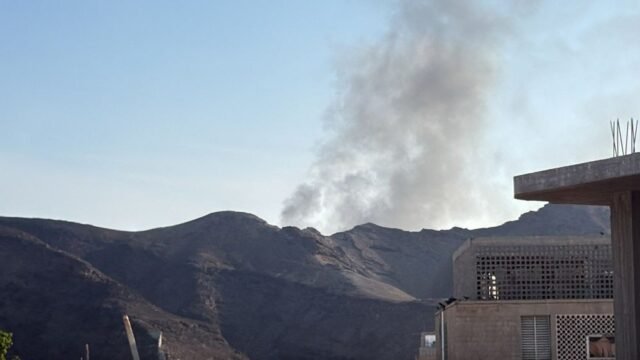
Bahrain’s Defense Ministry said the armed forces of this Arab Persian Gulf country on Sunday intercepted several “Iranian aerial threats” before they reached their targets. Bahrain’s Interior Ministry also issued two warnings to residents on Sunday morning, advising them to take shelter.
No immediate reports of injuries or damage were published. The Islamic Revolutionary Guard Corps claimed that the Islamic Republic’s forces had targeted a radar system at a Bahraini air base.
Bahrain also hosts a large US naval base. The US military did not immediately respond to a request for comment. Sunday’s attack came two days after the US military said it had shot down two drones fired by the Islamic Republic toward Bahrain, with no injuries or damage.
The IRGC said Friday’s attack was retaliation for an earlier US strike on a telecommunications tower in Iran.
The attacks were the first to target Bahrain in about two months. After the US and Israel attacked Iran in February, the Islamic Republic carried out thousands of retaliatory missile and drone attacks against Arab Persian Gulf countries that host US military facilities. But those attacks had largely subsided, as the two sides had entered a deadlock.
Now that the conflict has reached a deadlock and few signs of progress toward a lasting peace agreement between the US and the Islamic Republic are visible, mutual strikes between the two sides have resumed.
According to US officials and other people briefed on the consultations, US and Israeli military officials have also prepared plans for fresh strikes that would likely target energy infrastructure and other points vital to Iran’s economy.
US military assets have poured into the Middle East in recent weeks. A US military official who asked not to be named in order to discuss operational matters said on Sunday that the USS Theodore Roosevelt (USS Theodore Roosevelt) would join two other aircraft carriers in the Middle East within the next day.
Esmail Baghaei, spokesman for the Islamic Republic’s Foreign Ministry, said on Sunday that the Islamic Republic would respond to any military aggression by the US or others.
Baghaei, at a press conference in Tehran, in response to a question about whether the Islamic Republic’s attack in Bahrain signaled a change in the country’s approach and whether the Islamic Republic was still waiting for a formal US response in the negotiations, said the Islamic Republic “is waiting for no one” and is focused on protecting its own security.
Trump has been ambiguous about whether he might order a return to all-out war. The first campaign failed to force the Islamic Republic to abandon its nuclear program, but it roiled global energy markets — a factor that played a role in the heavy defeat of the Republican Party in the recent midterm elections.
It is not at all clear whether a fresh US or Israeli attack on Iran could force Tehran into new concessions. The country has said it rebuilt its military capabilities during the ceasefire, and US and Israeli officials must also consider whether they are willing or able to contend with missile and drone attacks by the Islamic Republic across the Middle East, given their depleted stocks of aerial interceptors.
Mediators from Qatar and Pakistan have traveled back and forth to Tehran in recent weeks to prevent a return to all-out war. Baghaei said on Sunday that Abbas Araghchi, the Islamic Republic’s foreign minister, would travel to Pakistan and Oman in the coming days.
Vice President JD Vance had supported the mediators’ efforts to find a diplomatic way to end the war and had also publicly blamed the war for the Republicans’ losses in the midterm elections.
Trump has now sidelined Vance from the negotiations and wrote on social media on Thursday that the United States does not need a deal with the Islamic Republic.
He said: “Those days are long gone.”
Background: A carrier strike group is the US Navy’s principal combat formation, built around a nuclear-powered aircraft carrier and usually including Aegis-equipped guided-missile destroyers and cruisers, an attack submarine, and dozens of fighter jets and support aircraft. The simultaneous presence of three strike groups in the Middle East, last seen on the eve of the Iraq War in 2003, is a sign of Washington’s high level of readiness to resume large-scale operations.
Analysis: The timing is the tell. The strikes resumed after a two-month lull at precisely the moment the talks hit a wall — for Tehran, the drone is a negotiating instrument, not an alternative to negotiation. Qatari and Pakistani mediators can work to prevent a return to full-scale war, but the Islamic Republic has little left to offer Washington in exchange for restraint. Each salvo burns through a finite inventory and hands the United States a fresh reason to keep three carrier strike groups in the region. Escalation born of deadlock, against an opponent in no hurry to reply, rarely ends well for the weaker side.