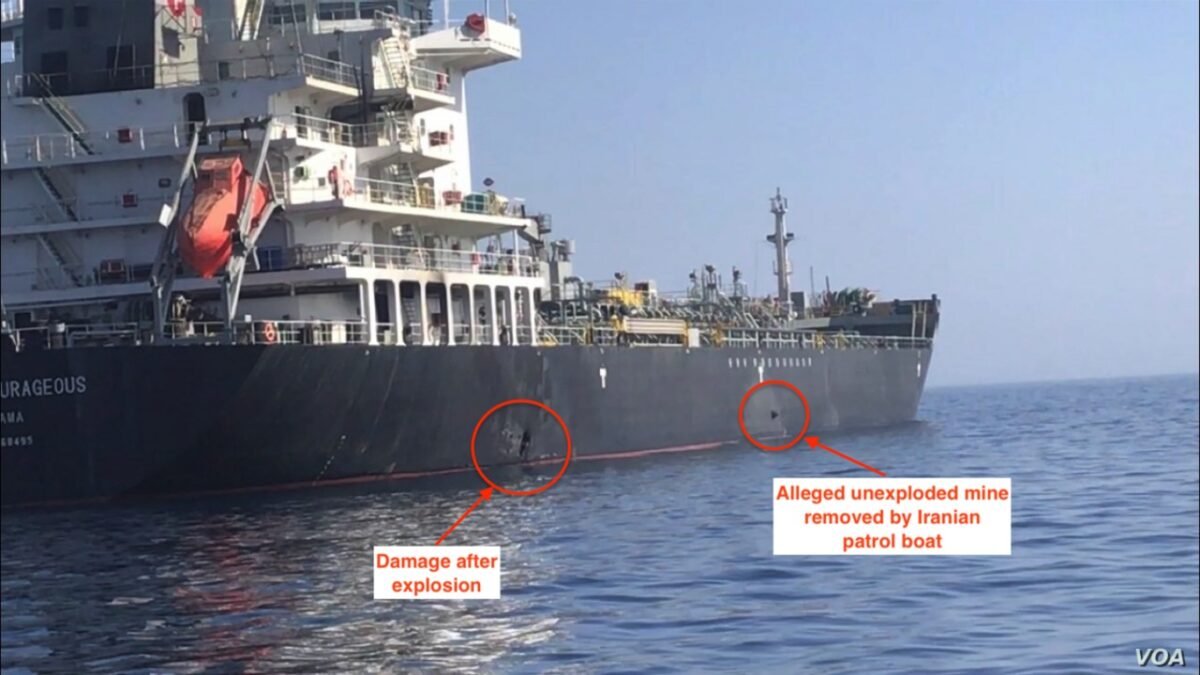
The Islamic Revolutionary Guard Corps said on Sunday that a supertanker carrying more than two million barrels of oil sank after striking a mine and catching fire in the Strait of Hormuz.
The IRGC said the vessel was one of two ships that struck mines while transiting the vital trade corridor, but there was no independent confirmation of the incidents.
Since the start of the Middle East war in late February, Tehran has sharply restricted traffic through the strategic waterway and insists that vessels use the Islamic Republic’s authorized routes.
The country has regularly targeted ships that transit without its permission.
In response, the United States has imposed a naval blockade on Iran’s ports and has helped tankers travel through the strait, which normally carries about one-fifth of the world’s oil.
The US military recently claimed that it had cleared all mines from the main routes through the waterway.
In a statement broadcast by state television, the Islamic Revolutionary Guard Corps said: “In the past few hours, two oil tankers traveling along an unauthorized route in the southern part of the Strait of Hormuz struck naval mines, which led to massive explosions and fire.”
The statement added: “One of these vessels — a supertanker carrying more than two million barrels of crude oil — sank in the southern waters of the Persian Gulf.”
The statement did not specify the tankers’ names or origins.
In recent weeks, Tehran has issued numerous announcements saying that ships have caught fire in the strait, and has often claimed that they struck mines.
US Central Command, which oversees US military operations in the region, has supported ships transiting the waterway and said last month that since the summer it has helped Gulf states export 1.5 billion barrels of oil through Hormuz.
A British maritime monitor said on Sunday that it was aware of a report by Indian shipping authorities of an attack on a tanker in the Gulf, but it was not clear whether it was the same incident announced by the IRGC.
The United Kingdom Maritime Trade Operations centre said the damage and environmental impact were unknown but the crew were safe.
Background: The Strait of Hormuz is the world’s most important energy chokepoint, and a large share of the Persian Gulf’s exported oil and liquefied gas passes through it; for that reason, mining it has been one of the Islamic Republic’s oldest tools for threatening shipping. Supertankers are also the world’s largest oil tankers, each typically carrying about two million barrels of crude oil, and damage to one of them could have wide-ranging environmental and economic consequences.
Analysis: There is no independent confirmation of the sinking, and that absence is itself the news. An unverified tale of mines and a sunken tanker is a cheap weapon for Tehran: it lifts insurance rates, manufactures fear and consumes not a single real mine. Set against it is CENTCOM’s figure — 1.5 billion barrels of oil moved through Hormuz with American help since the summer. The strait is not closed; it is operating under US escort, and operational control of it has slipped from the regime’s hands. What Tehran has left is the threat of mines, and every unproven claim spends a little of that threat’s credibility — credibility it would need on the day it ever tried to close the strait in earnest.