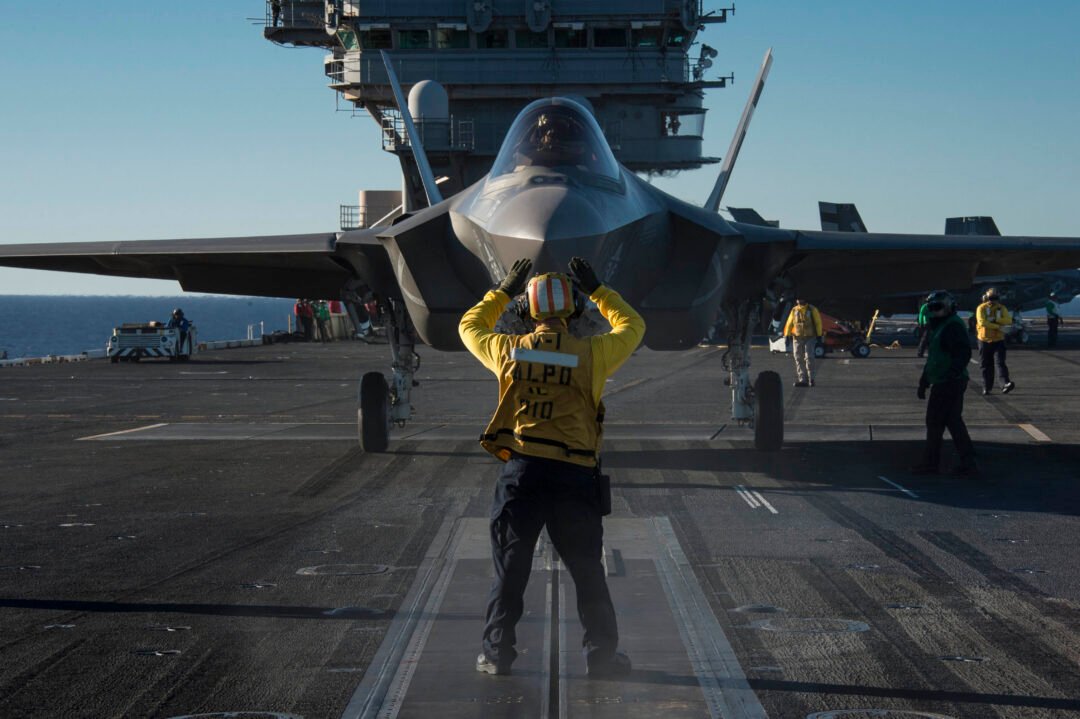
Lockheed Martin said on Thursday that two F-35C Lightning II fighters have completed the jet’s first round of launch and recovery testing aboard the future USS John F. Kennedy (CVN-79), the Navy’s second Gerald R. Ford-class aircraft carrier.
The trials, run over 11 days beginning October 13 as part of the ship’s aircraft compatibility testing, saw the two jets from Air Test and Evaluation Squadron 23 make 34 flights, logging 122 catapult launches and 122 arrested landings. The first arrested landing came on October 13 and the first catapult launch on October 14.
Unlike the Nimitz class, which relies on steam catapults and hydraulic arresting gear, Ford-class carriers use the Electromagnetic Aircraft Launch System and Advanced Arresting Gear. Lockheed Martin says the electromagnetic system delivers smoother, more precisely controlled launches, while the advanced arresting gear covers a broader range of recovery conditions. With this test phase complete, the Navy has cleared the F-35C for operations across its entire carrier fleet, though full deployment readiness still requires supporting equipment to be installed.
Background: The Kennedy received its F-35C modifications during construction, and formal delivery is planned for spring 2027. The F-35C first landed on a carrier in November 2014, aboard USS Nimitz, and has since deployed from modified Nimitz-class ships.
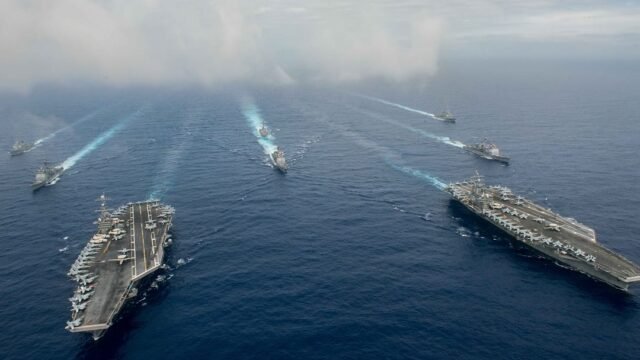
Analysis: Pairing a fifth-generation fighter with the Ford-class flight deck joins the world’s most advanced carrier technology to its stealthiest carrier-based jet. With carriers serving as the backbone of the naval blockade of the Islamic Republic and of deterrence against China, this integration secures the reach and striking power of the US carrier air wing for years to come.
Source: Military Times