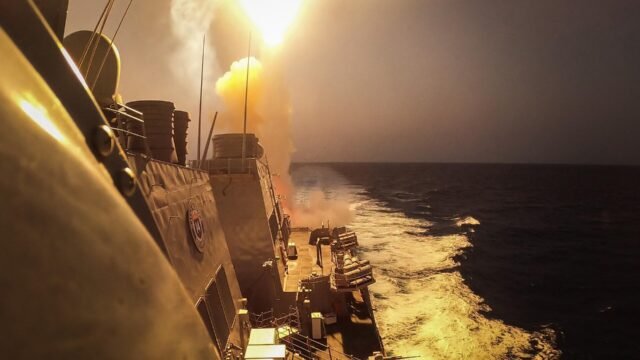
The Islamic Republic’s Foreign Ministry issued a statement on Wednesday saying the regime’s military operations against American forces amounted, in Tehran’s view, to legitimate self-defense.
In the statement, carried by state media, regional governments were urged to prevent the United States from using their territory, bases and facilities to plan and carry out attacks against Iran, and were warned that a repetition of what was called aggression would meet a decisive response.
Tehran also claimed its forces had targeted air defense systems, Patriot batteries and US missile launch platforms at two regional bases during the recent exchanges, and condemned a US strike on Iranian vessels near Iran’s southern coast.
The statement came a day after the United States struck an IRGC missile launch site on Qeshm Island. Bahrain’s military reported intercepting Iranian aerial attacks, and US Central Command said Iranian drones launched toward Bahrain were intercepted, with no damage to American equipment and no injuries to US personnel.
Background: US bases in Persian Gulf states have become a central axis of the confrontation in recent weeks. By targeting those bases the Islamic Republic seeks to raise the cost of the American military presence for its regional hosts, while Washington treats the same bases as the backbone of its containment and military pressure on the regime.
Analysis: The warning to neighbors is an implicit admission that the architecture of US bases is working. A regime that claimed deterrence is now trying, by threatening host governments, to loosen the ring around it. The recent exchanges have shown that most of the Islamic Republic’s attacks on regional bases are intercepted, and their practical result has been deeper US air-defense coordination with Persian Gulf states, not an American retreat.