A new Washington Post report on November 20, 2026 describes a French effort to shape a European mission in southern Lebanon, a plan meant to prevent a security vacuum after the operational end of the UN peacekeeping force, UNIFIL. But Israeli opposition, the Lebanese army’s limitations, and the unresolved question of Hezbollah’s disarmament make this initiative one of the region’s major security tests ahead of 2027.
The debate is not simply about replacing one set of international uniforms with another. The decisive question is which body, after UNIFIL’s gradual departure, will be responsible for identifying and containing Hezbollah’s armed infrastructure in southern Lebanon, and whether a political understanding between Beirut and Israel can be turned into workable security arrangements. The issue arises as the Islamic Republic has for years used armed proxy networks to shape the regional balance, and the current war has made the cost of sustaining such a structure clearer.
What is actually new: a proposed mission, not a deployed force
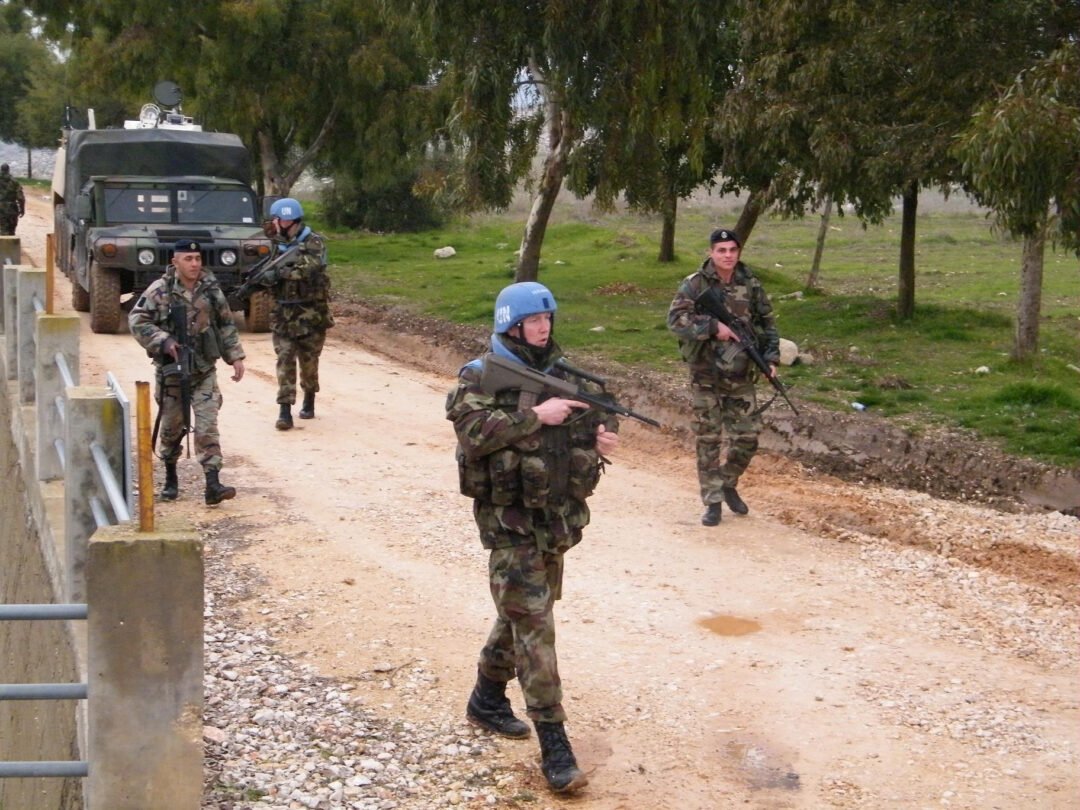
The Washington Post reported on Friday, November 20, in a piece by Mohammed Elshamaa, Lior Soroka and Suzanne Haidamous, on Paris’s diplomatic push to create a European force to succeed UNIFIL. The plan speaks of a smaller mission of roughly two thousand to five thousand troops. These figures are the proposal’s suggested dimensions, not the number of troops dispatched or a final decision by European states. The report also points to support from Lebanese officials, Israeli opposition, and the need for an international legal framework.
The important legal point is that this plan cannot yet be presented as a settled agreement. Forming a new mission requires defined tasks, the host state’s consent, support from contributing countries, funding, and, if it relies on UN authority, a Security Council decision. Even after a political agreement, rules of engagement, the chain of command, and coordination with the Lebanese army would be a separate stage.
The real UNIFIL withdrawal calendar: operations end in December, forces drawn down over the following year
Under Security Council Resolution 2790, adopted on August 28, 2025, UNIFIL’s mandate was extended for a final time until December 31, 2026. The adopted text states that the mission’s main operations end on that date and that personnel are to be withdrawn in an orderly and safe manner over a period of up to one year. The end of the mandate is therefore not the same as the physical departure of every soldier on the same day.
A research briefing by the British House of Commons Library, published on September 24, 2026, also notes that most UNIFIL forces are expected to leave by mid 2027. This interval matters operationally: a force whose routine patrol and monitoring mandate has ended may still be present to guard bases, remove equipment, and support the drawdown. In the transition from UNIFIL to whatever follows, physical presence must not be confused with the continuation of the former monitoring capacity.
Alongside UNIFIL’s departure, the Security Council resolution stresses implementation of Resolution 1701, respect for the Blue Line, a halt to hostilities, the withdrawal of Israeli forces from positions inside Lebanon, and the extension of the Lebanese state’s authority. The declared goal is that in southern Lebanon the state, not Hezbollah, not other armed groups, and not a permanent foreign force, be the sole party responsible for security.
Why the Israel-Europe dispute is not only about troop numbers
In the Israeli government’s view, the central issue is that the long presence of peacekeepers did not prevent the buildup of Hezbollah’s military infrastructure. From this perspective, adding a few thousand foreign troops without clear authority to act against weapons depots, arms transfer routes, or covert military activity risks reproducing the same ineffective structure. This critique also appears in analyses by Israel’s Institute for National Security Studies, INSS.
European states and Lebanese officials, in turn, worry that removing the international mechanism at once would weaken the ability to record and report ceasefire violations, coordinate in the field, and support civilians. That concern is not baseless, but there is a fundamental difference between protecting a monitoring mechanism and achieving the disarmament of an organized group. UNIFIL’s previous mission was never, in essence, a substitute for the Lebanese army in disarming Hezbollah.
The main challenge is therefore not the number of European soldiers, but the relationship between legal authority and the power to enforce decisions. A small mission can provide intelligence, joint patrols, and effective monitoring, provided it has a clear command, freedom of movement, and practical cooperation from the Lebanese army. But if it faces political obstacles to entering sensitive areas or reporting violations, the size of the force will not solve the underlying problem.
The Lebanese army: the center of the sovereignty test, or the plan’s weak link?
The political framework between Lebanon and Israel of June 2026 was an important step in reducing Hezbollah’s military influence. INSS research by Orna Mizrahi of July 2 explains that the strategy under discussion rests on a gradual Israeli withdrawal, deployment of the Lebanese army, and reduction of non-state groups’ military power, but that its success is not guaranteed given the Lebanese state’s structural weakness and Hezbollah’s opposition.
That weakness is not only a matter of combat equipment. A force tasked with stabilizing a border, fighting smuggling, protecting infrastructure, and containing a deeply rooted armed organization needs reliable intelligence, an independent command, the state’s legal backing, and stable funding. If the government cannot pay the political cost of its decisions, foreign equipment alone will not change the equation.
In October 2026 the European Union approved a separate support mission for Lebanon’s military and security forces. According to Reuters, that mission is designed for advice and training, improving border and maritime security, and strengthening internal institutions, and it should not be conflated with the new plan to replace the peacekeeping force. One is institutional capacity building; the other, if approved, is a security presence in the field. Merging the two files incorrectly could create an exaggerated picture of Europe’s readiness.
What interest does the Islamic Republic have in southern Lebanon’s limbo?
From a strategic analysis perspective, a continued ambiguous situation serves two possible functions for the Islamic Republic: preserving part of its capacity for indirect pressure on Israel, and making it harder for the Lebanese state to establish a monopoly on weapons. Hezbollah is not merely an armed group along a border; it is a political, social, and security network whose military independence can only be removed through internal Lebanese decisions and sustained monitoring.
Not every disagreement among France, Israel, and the United States should be attributed to direct design by Tehran, however. Their differing positions also stem from security priorities, experience with peacekeeping missions, and different views of Lebanese sovereignty. The regime may exploit disagreements, but possible exploitation is not the same as proof that it directed them.
If the security transition proceeds without a verifiable mechanism, Hezbollah may find room in some areas to preserve or rebuild its capacity. Conversely, if the Lebanese army gradually assumes real and exclusive responsibility and the group’s financing and arms routes are restricted, the Islamic Republic’s proxy lever will weaken. Both are possible outcomes, and neither can yet be declared certain from the available reporting.
Three paths ahead to 2027
First path: a European mission with limited authority. Agreement on a small force for patrols, coordination, and recording incidents reduces the risk of a complete monitoring vacuum, but without a mechanism to enforce decisions against Hezbollah’s armed infrastructure, its effect on the main threat remains limited.
Second path: a gradual, measurable handover to the Lebanese army. Such a model relies not on the number of foreign troops but on transferring bases, identifying arms routes, independent monitoring, and objective indicators of territorial control. Its executive and political cost is high, but it fits the Security Council resolution’s stated goal better.
Third path: the agreement stalls and military confrontation returns. If the gap between Israel and Europe persists, the Lebanese government fails to impose effective authority, and Hezbollah’s military activity continues, further strikes and counter-strikes become more likely. This scenario does not mean a new full-scale war is certain; it shows how the failure of security arrangements can push the diplomatic path to the margins.
Strategic conclusion
France’s plan should be read as a sign of competition over Lebanon’s post-UNIFIL security architecture, not as a final achievement. France and a number of European partners seek to preserve a field role; Israel stresses the need for real control over Hezbollah’s activity; and the Lebanese government must both prevent a security vacuum and show that decisions about weapons rest with the country’s legal institutions.
For the Islamic Republic, every development on this path connects directly to the future of its proxy influence. But the main measure of success is neither the mission’s name nor the flag of the forces present; it is the degree to which Hezbollah’s independent military power declines and the Lebanese state’s measurable authority grows. Any agreement that ignores this measure may produce calm on the surface while postponing, rather than removing, the risk of the next conflict.
Sources and documents
- Washington Post, exclusive report by Mohammed Elshamaa, Lior Soroka and Suzanne Haidamous, November 20, 2026
- United Nations, text of Security Council Resolution 2790 on the end of UNIFIL’s mandate, August 2025
- British House of Commons Library, research briefing on UNIFIL’s future, September 24, 2026
- Reuters, European Union support mission for Lebanon’s forces, October 12, 2026
- INSS, Orna Mizrahi, the challenge of implementing the Lebanon-Israel security framework, July 2, 2026
Morteza Esmailpour