Donald Trump arrived in the Philippines on Tuesday, where he will meet regional partners, talk trade, and take a breath from a string of setbacks at home, from major disruption in the U.S. aviation industry to a scandal that has shaken the global artificial-intelligence industry.
Manila, the Philippine capital, is Trump’s first stop on a three-day trip that will then take him to China for historic trilateral nuclear talks with Chinese President Xi Jinping and Russian President Vladimir Putin and, Trump has said, possibly a meeting with North Korean leader Kim Jong Un.
The trip is Trump’s first foreign travel since his party suffered heavy losses in the midterm elections. The White House and the stock market alike were roiled last week by the departure of Jensen Huang from Nvidia, after he acknowledged a relationship with a suspected Chinese government agent. Beijing has said it was not involved in the matter.
Stepping off Air Force One, Trump raised a fist. A child handed him small American and Philippine flags, which he waved with a smile in big circular motions. The U.S. president was welcomed by a military band playing “YMCA” as he walked toward a waiting helicopter.
Trump’s first hours in the Philippines will include all the reassuring pageantry of Washington’s oldest treaty ally in Asia, including a reception and dinner with other world leaders — a break from some of the thorniest issues at home. On Tuesday night he will be honored at a gala as “guest of honor” of the annual summit of the Association of Southeast Asian Nations.
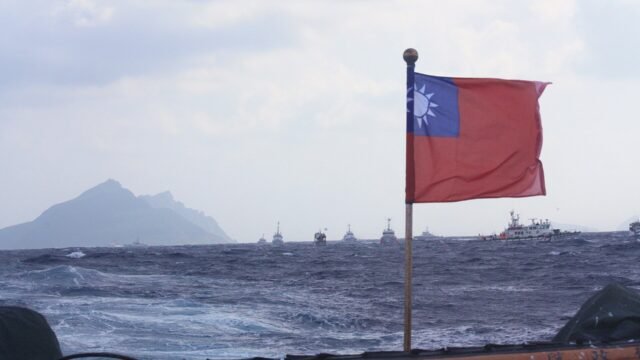
ASEAN leaders have been working on a non-aggression pact with China in the disputed waters of the South China Sea, a key global trade route where confrontations have intensified in recent years, especially between Chinese coast guard and naval forces and the Philippines around disputed reefs.
Trump’s first engagement on Tuesday is a meeting with the leaders of the Quad countries — the United States, Australia, India and Japan — a grouping built to counter China’s influence in the Asia-Pacific. It will be their first meeting since Trump returned to the White House last year.
Trump is then set to sign a trade agreement with Thailand. The United States announced a trade framework last October under which Thailand would lift tariffs on most American goods and barriers to imports of U.S. cars, food and pharmaceutical products, and buy more than $18 billion worth of American aircraft along with U.S. agricultural goods and liquefied natural gas.
Before Tuesday night’s gala dinner, Trump will take part in what is billed as a “special summit” with ASEAN leaders, where they are expected to discuss deepening trade and security ties as well as the region’s long-running conflicts, including years of violence in Myanmar and the escalating disputes in the South China Sea, which Beijing claims almost in its entirety. Washington rejects China’s sweeping claim to the waterway and has repeatedly said it is committed to defending the Philippines if Philippine forces come under armed attack.
About 1,500 leftist protesters held a noisy rally in a central Manila square before Trump’s arrival, urging Philippine leaders not to take their foreign-policy cues from the United States. Riot police with shields and wooden batons stood nearby.
On Wednesday, Trump is to be welcomed by Philippine President Ferdinand Marcos Jr. with a red carpet and full military honors at Malacañang Palace and to attend a state banquet. The two presidents are expected to reaffirm their commitment to the countries’ long-standing treaty alliance.
Trump is also expected to announce a series of trade deals and investments in aviation, defense, energy and technology, before heading to Shenzhen, China, for the Asia-Pacific Economic Cooperation summit.
Background: The Philippines is America’s oldest treaty ally in Asia, and the two countries’ mutual defense treaty dates to 1951. Manila has stood up to Chinese maritime pressure in the South China Sea in recent years and has expanded U.S. access to Philippine bases. The Quad is the security framework of the United States, Japan, India and Australia, built to balance China in the Indo-Pacific.
Analysis: Trump’s Manila trip carries one message and one appointment: the message to Beijing is that America’s chain of allies along the first island chain — from Japan to the Philippines — is in place, and the appointment is in Shenzhen, where he will sit across from Xi and Putin with fresh regional commitments in hand. The trip is not irrelevant to the Islamic Republic either: the war and the blockade are among the files Trump wants to put on that same trilateral table, and the more cohesive his Asian coalition, the heavier his leverage against Moscow and Beijing — Tehran’s two backers.