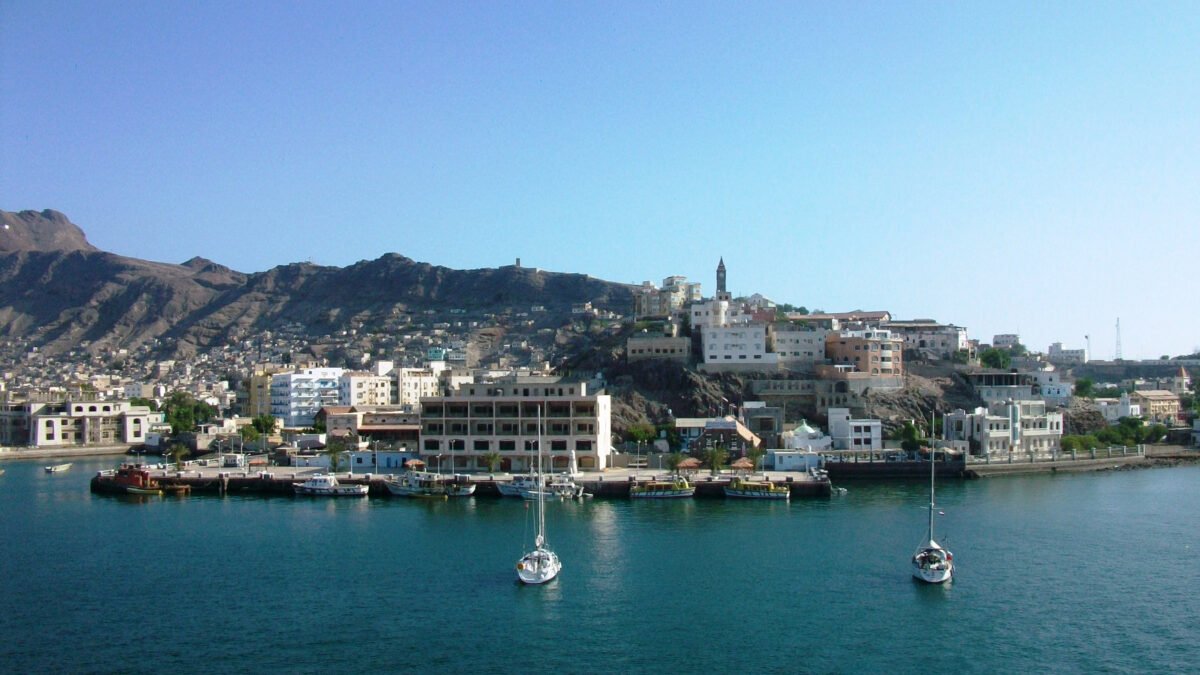
Yemen’s Houthi rebels have seized a strategic district west of the port city of Aden, home of the internationally recognized government.
Analysts fear Aden could fall to the Iran-backed group, leaving them in control of the entire Red Sea coastline of Yemen and, with it, the ability to disrupt one of the world’s most crucial shipping lanes.
The Houthis attacked Zinjibar district in Abyan province last week before seizing al-Wahda district, a gateway to Aden’s western districts of al-Buraiqeh and al-Shaab, on Sunday. The group, formally known as Ansar Allah, is now about 10 miles (16 km) from Aden.
“There’s no strong force to push them back now,” Ali al-Ghaithi, an independent Yemeni military analyst, told the BBC.
“They’re taking advantage of the power vacuum and the chaos that is happening with the internationally recognized government. Aden could fall. There is a significant risk.”
The Yemeni government has been locked in a power struggle with separatists known as the Southern Transitional Council (STC), which has controlled Aden since 2019.
STC leaders have complained that the government’s Presidential Leadership Council (PLC) has not provided them with money and military support to hold off the Houthis’ latest advance.
Meanwhile, PLC head Rashad al-Alimi visited Riyadh on Monday to request support from Saudi Crown Prince Mohammed bin Salman. The Saudi-led coalition also flew troops into Aden’s airport on Sunday.
The Houthis have been expanding their reach since a fragile UN-brokered ceasefire with the government collapsed in 2022.
The Houthis control most of north-western Yemen, including the capital Sanaa. The internationally recognized government holds the south and east.
The latest offensive began after a Saudi-Emirati peace deal to end the war and lift the blockade on Yemen’s ports was shelved following the United States’ blockade of Iran, the Houthis’ main backer, in May 2026.
Since then, the Houthis, supported by Tehran, have become bolder. They have repeatedly targeted commercial shipping in the Red Sea, including Greek-managed bulk carrier the Eternity C, which was sunk in July 2025, with four crew members killed.
A month later, they raided the UN’s World Food Programme offices in Sanaa, detained staff, and have since sentenced three of them to death.
The Houthis have also been trying to expand their influence over the Red Sea’s African coast. At a summit in Sanaa in September, the group signed security agreements with Eritrea and Sudan’s Rapid Support Forces (RSF), both seen as hostile to Egypt, whose economy depends heavily on Suez Canal revenues.
Since October 2023, the Houthis have been threatening Persian Gulf oil trade, launching attacks on shipping in response to the US-Israel war on Iran.
At the same time, Houthi leaders remain fearful of US airstrikes, which hit them hard during Washington’s bombing campaign in 2024-25. Donald Trump also targeted Houthi missile production facilities in the first three days of the war with Iran in March, striking production plants and the Houthi leadership in Sanaa, including the group’s second-in-command, Abdul Malik al-Houthi’s brother-in-law, Abdul Khaleq Badr al-Din al-Houthi.
However, if the Houthis manage to seize Aden, they will be able to reinforce their stranglehold on the strait of Bab al-Mandab, which connects the Red Sea to the Indian Ocean via the Gulf of Aden, a second key chokepoint in global trade.
The United Nations says Yemen’s war has caused one of the world’s worst humanitarian crises, with 60% of deaths attributed to indirect causes like lack of food, healthcare and infrastructure.
Background: Bab el-Mandeb, at the southern mouth of the Red Sea, is one of the world’s most important maritime chokepoints: before the war, roughly 12 percent of global trade and a large share of Europe’s energy passed through it. Aden, at the strait’s eastern entrance, is Yemen’s main southern port and the seat of the internationally recognized government; its fall would put both shores of the chokepoint within reach of the Houthis.
Analysis: The Houthi advance is the southern wing of the same war: as Tehran loses Hormuz, it pushes its proxy to open a second front at Bab el-Mandeb, so the world’s trade is squeezed from both sides. The fall of Aden would be a strategic defeat for Riyadh and a direct threat to Egypt’s Suez revenues, which is why the answer cannot be only Yemeni. The same coalition that closed Hormuz to the regime will eventually have to decide that Iran’s last maritime lever also has to be broken.