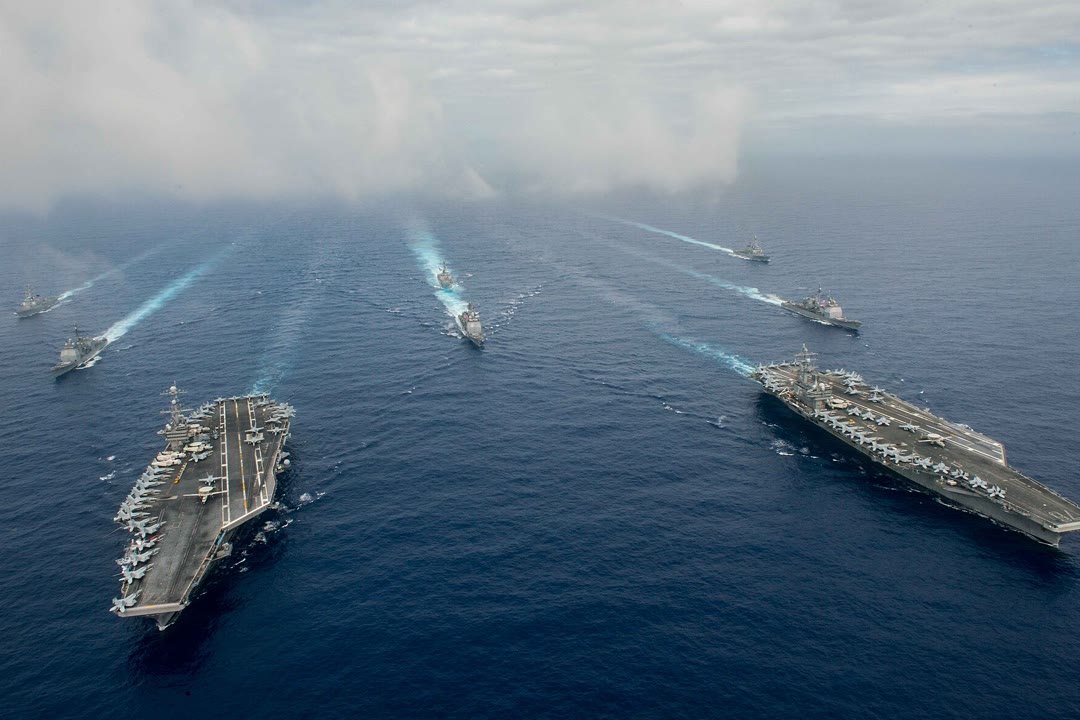
The Associated Press reported that the US military has returned to having two aircraft carriers supporting war operations against the Islamic Republic, after the USS George Washington departed the Middle East. Commander Katie Koenig, a spokesperson for the US Pacific Fleet, said on Wednesday that the Japan-based George Washington is now under that fleet’s control and conducting routine operations in the Asia-Pacific region.
The change is precise. The George Washington left in the same week the USS Theodore Roosevelt arrived, briefly lifting the number of American carriers in the waters off the Islamic Republic to an unusual three. The two now remaining are the USS George H.W. Bush, which arrived in the region in April, and the Roosevelt, accompanied by more than a dozen destroyers, cruisers and a littoral combat ship.
During this war the carriers have been the linchpin of the flotilla that has blockaded merchant shipping to and from the Islamic Republic, as the Trump administration squeezes Tehran’s economy by keeping its oil off global markets. The United States has also carried out limited strikes on targets in the Strait of Hormuz, the waterway through which nearly a third of the world’s oil passed before the war began on February 28.
The George Washington had arrived in August, pulled from a patrol in the South China Sea after reports of mental health and supply problems aboard another long-deployed carrier in the region, the USS Abraham Lincoln, which set a record of more than 240 days of uninterrupted time at sea. The latest shuffle is a planned rotation, and Washington has warned in parallel that its military is locked and loaded and that it is watching Pickaxe Mountain, a facility linked to the Islamic Republic’s nuclear program, for signs of activity.
Background: Keeping two carriers in the Middle East at once is a level of naval power the United States normally sustains only at the height of a crisis. Rotating the Bush and the Roosevelt in as the Washington departs shows the presence is not meant to thin out when one ship’s tour ends, and that the naval blockade of the Islamic Republic keeps its full air cover.
Analysis: The message of the shuffle for Tehran is plain: one carrier’s departure does not mean lighter pressure. The blockade that has closed off the regime’s oil artery continues behind two carrier strike groups, and any attempt by the Islamic Republic to break it meets carrier-based air power. The Strait of Hormuz, which the regime treated as its own pressure lever, now sits under the permanent shadow of that fleet, and that is exactly where Tehran’s calculations grow harder by the day.
Source: Associated Press