Pentagon policy chief Elbridge Colby on Tuesday cautioned European NATO allies against excluding U.S. firms from weapons deals, as they heed Washington’s calls to arm up and shed dependence on the United States for the continent’s conventional defence.
“We understand European populations need to benefit from greater defence spending. That’s only fair and reasonable,” Colby said after a meeting at NATO’s Brussels headquarters. “But American companies make the best weaponry in the world. If you’re going to have a secure Europe in NATO 3.0, you need things like the (U.S. fighter jet) F-35.”
Colby said the U.S. was not insisting on American-only production and was ready to help along collaboration of the defence industries, but it had to be a “pragmatic, balanced relationship.”
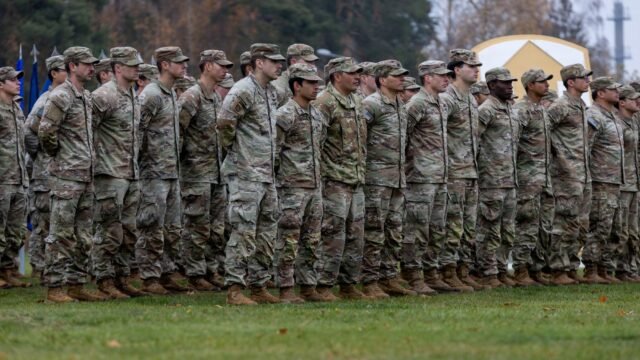
Responding to questions on the timeline and scope of a potential drawdown of U.S. troops in Europe under an ongoing review, Colby said he was still hopeful a December 1 deadline for the review would be met. Defense Secretary Pete Hegseth unveiled the six-month review in June. Colby did not explicitly say it could lead to cuts in the 80,000 U.S. troops deployed to Europe, but stressed the goal of prompting the continent to do more while enabling the U.S. military to meet global commitments.
He praised allies such as Germany, the Scandinavian countries, Poland and the Netherlands for making progress, while stressing the urgency for others to fall in line. “We’re going to allocate our military where it’s most needed for Americans,” he said, singling out the Western Hemisphere and the Indo-Pacific. “That doesn’t mean abandoning Europe. Rather, it means a different, rebalanced relationship with your allies… which is based on military readiness.”
Speaking before the meeting, German Defence Minister Boris Pistorius said he expected more clarity on the scope of any U.S. drawdown within weeks. “We expect changes in troop levels, but we don’t know anything concrete yet… But again, a shift in the balance of conventional forces would have occurred under any other president, due to increased engagement in the Indo-Pacific.” Germany hosts about 35,000 U.S. troops, the largest American military presence in Europe. European military sources have speculated Washington might move a brigade or some 5,000 troops from Germany either to Asia or closer to NATO’s eastern flank in Poland.
The meeting of the Ramstein Group of Ukraine’s military supporters at NATO headquarters discussed how to supply more arms to Kyiv ahead of a harsh winter, while Russia steps up air strikes on civilian infrastructure. Pistorius said Germany and Norway would sponsor another package of U.S. weapons under the PURL programme, focusing on supplying more PAC-2 and PAC-3 missiles for the Patriot air defence system to Ukraine. He put Berlin’s contribution to the package at some $300 million. Germany is also working to integrate its IRIS-T missile with Norwegian NASAMS air defence systems and will deliver additional radars as well as drone and fighter jet ammunition. “We will… once again appeal to everyone’s sense of responsibility,” Pistorius underlined, alluding to allies such as Greece which still have large stocks of Patriot missiles. Support for Ukraine was not a charity event, he added: “It is about the security of Europe, and it is about stopping Vladimir Putin and putting him in his place.”
Background: “NATO 3.0” is the Trump administration’s term for an alliance in which Europe carries the main burden of the continent’s conventional defence while the United States concentrates on global deterrence and other fronts. Hegseth’s review is due by December 1 to determine how much of the 80,000-strong U.S. presence in Europe will move.
Analysis: Colby’s message cuts two ways: Europe must spend more, but on American weapons and inside Washington’s architecture. It also bears directly on the current war. Every Patriot battery and every thousand troops Europe provides for itself frees American hulls and interceptors for the main front, the Middle East and the contest with China. The “rebalance” does not mean America leaving Europe; it means Washington will no longer pay alone for readiness on every front, a pressure that ultimately works in favor of concentration on the regime and the Hormuz blockade.
Source: Reuters