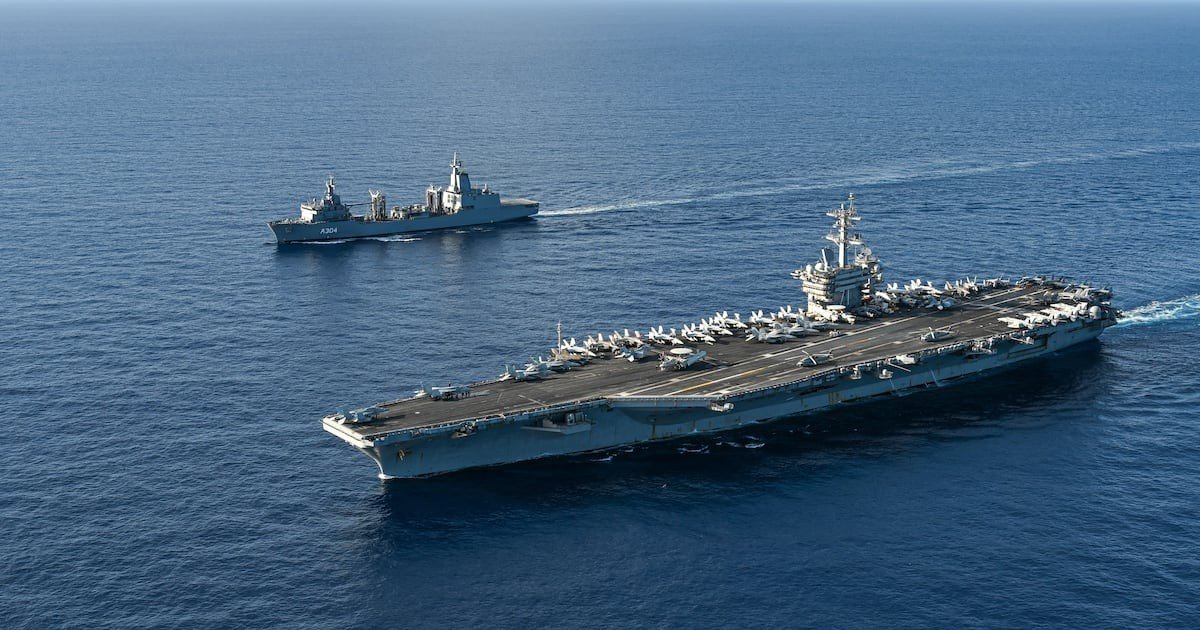
A U.S. official told The National that the aircraft carrier USS Theodore Roosevelt (USS Theodore Roosevelt) entered the Middle East on Sunday.
That means Washington now has three carrier strike groups in U.S. Central Command’s area of responsibility.
Roosevelt was initially due to replace USS George Washington (USS George Washington), although that carrier has for now remained in the region.
The nuclear-powered warship entered the region as the Islamic Republic on Sunday attacked a base in Bahrain that hosts U.S. military assets. It was Tehran’s first attack on a Gulf Arab country in recent weeks, and the Islamic Revolutionary Guard Corps said it had launched drones toward the site.
Meanwhile, the Islamic Republic’s state television said five ships had struck mines and caught fire in the past 48 hours, without identifying them.
The United Kingdom Maritime Trade Operations said Indian shipping officials had reported an attack on an oil tanker in the Persian Gulf and that the crew were safe, although the extent of the damage was unclear.
The Revolutionary Guards also claimed on Friday that it had destroyed a U.S. early-warning radar in Bahrain, although U.S. Central Command said it had intercepted two drones launched by the Islamic Republic.
The developments come as diplomatic efforts to end the conflict, which began with U.S. and Israeli strikes in February, have yet to produce results.
Abbas Araghchi, the Islamic Republic’s foreign minister, will travel to Muscat on Tuesday for talks with his Omani counterpart.
The war began on February 28, when the United States and Israel carried out a joint attack against Iran to counter its nuclear program.
U.S. President Donald Trump is expected to meet Russian President Vladimir Putin and Chinese President Xi Jinping in Asia this week.
Background: U.S. Central Command (CENTCOM) is one of the U.S. military’s unified combatant commands, whose area of responsibility covers the Middle East and Central Asia, and all U.S. ground, air and naval operations in this region, including against the Islamic Republic, are conducted under its supervision. The deployment of three carrier strike groups in this area is the highest level of U.S. naval presence in the region in more than two decades.
Analysis: Three carrier strike groups in one theater is not a routine rotation; it is a deliberate concentration of force. The posture lets Washington hold the naval blockade, cover its bases and keep the strike option alive at the same time, without having to choose among the three. Araghchi’s trip to Muscat has to be read against that backdrop — diplomacy conducted under the shadow of three carriers is not a negotiation between equals. Tehran understands this, which is why its drones are over Bahrain: it needs to look as though it still holds a card.